Two Market Interventions in One Month — How I’m Thinking About the South Florida Real Estate Market
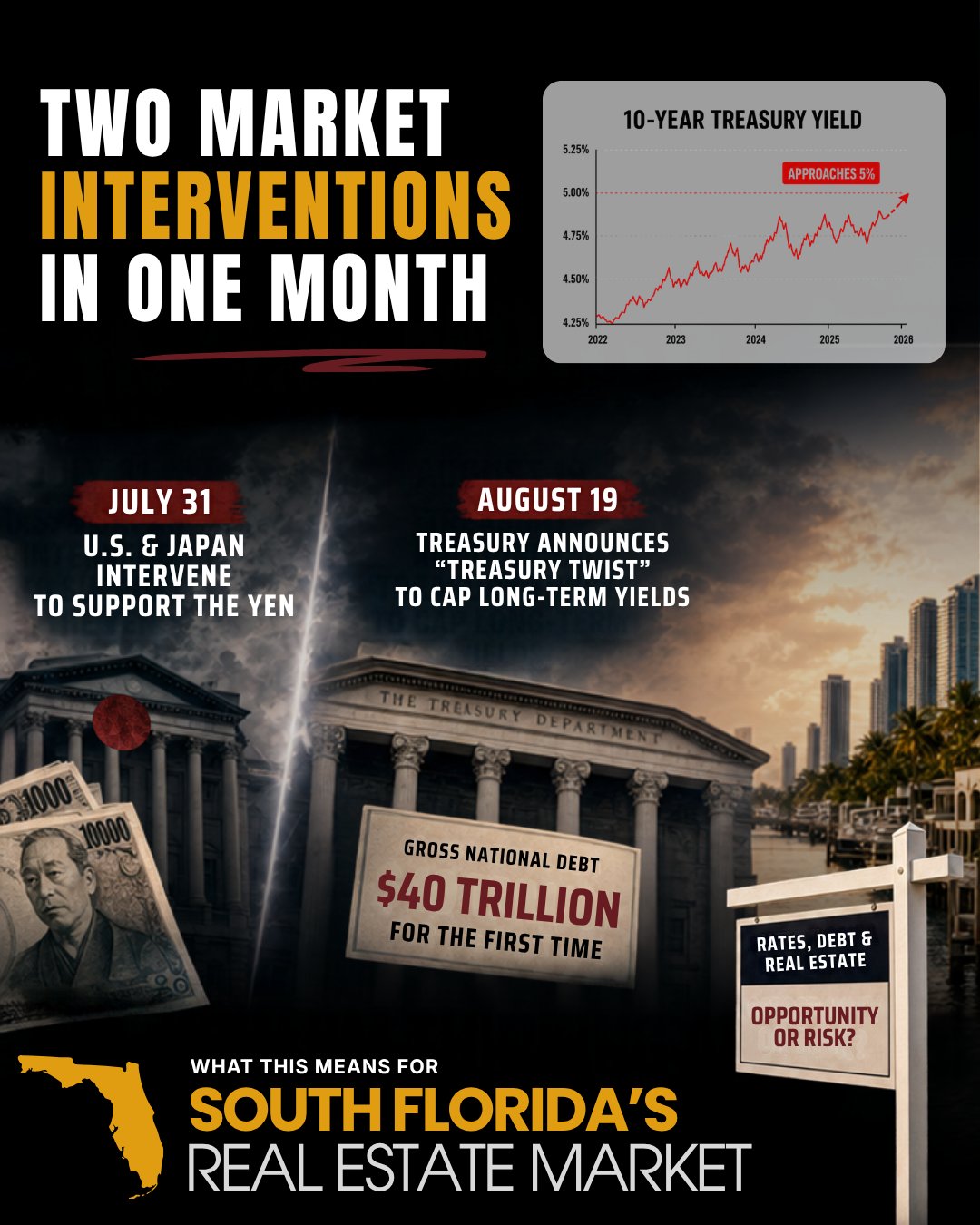
People don’t seem to be aware of what just happened, and it has prompted me to write this essay because I think this should be one of the most important discussion points currently. The media doesn’t seem to care either and people just go on about their lives… Over the past few weeks the U.S. has stepped into global markets twice to keep long-term interest rates from blowing out. Anytime the 10-year Treasury bond starts to approach 5%, we intervene.
The first came on July 31, when the U.S. Treasury and Japan's Ministry of Finance jointly bought yen, while the yen was at a 40-year low—the first coordinated intervention between the two countries since 2011. Our economy can’t withstand Japan selling U.S. treasury bonds to support its currency. Proof of this is that our Treasury Secretary, Scott Bessent, is pushing to expand the Fed facility that allows central banks around the world to raise dollars against their Treasury holdings instead of selling them.
Then came Besssent’s surprise announcement on August 19. After the 30-year Treasury climbed above 5.1%—its highest since 2007—and the 10-year hit 4.75%, Treasury announced it would at least double its buybacks of 10- to 30-year bonds, from $2 billion to $4 billion per operation, beginning September 9. Yields fell on the news, and then a day later were actually higher than they were before the announcement. Bitcoin and gold shot up on the news. Oh, and this announcement also hit on the same day our gross national debt hit $40 trillion for the first time. We hit $39 trillion about five months ago. Nothing to see here folks…
Bessent has come up with a cute term for this—“Treasury Twist,” which is basically buying long-dated bonds while selling short-term bills. While this technically did not add new dollars into the system, it signals to me that we have reached the next stage in the debt death spiral, and that the U.S. will need to continue to intervene in the bond market and eventually print a ton of dollars.
Mortgage rates are not set by the Federal Reserve. Thirty-year mortgages are priced off the 10-year Treasury plus a spread that widens with volatility. As long-term yields rise, mortgage rates follow, and housing slows. At a 10-year near 4.70% we get the mortgage rates for the 30-year in the mid-sixes. At 5.25% we get sevens, and a market that stops in its tracks. What the U.S. Treasury is defending is actually the cost of long money (not the stock market or the dollar), which is directly tied to the cost of shelter.
The problem here is that retiring long bonds with proceeds from short-term bills does not reduce debt. It reduces duration such that every long-duration bond retired this way becomes an obligation refinanced over and over at whatever the front end charges. As we continue to pile on more and more debt as a nation we issue increasingly more treasury bills to pay for it. We now have to roll that debt over every 1–12 months (instead of 10, 20 or 30 years). As of this writing markets now actually see the next Fed move to likely be a rate hike instead of a rate cut. Where do we think this puts us a year from now? This is a bad situation for a housing market that already has a lot of stress due to the K-shaped economy.
There is one historically reliable exit from that conundrum—holding interest rates below the rate of inflation and letting the real value of the debt erode, funded when demand falls short by a central bank balance sheet. That is called financial repression. My thesis is that it defines the next several years, and that it will never be announced as such.
If you use the Fourth Turning framework (if you have read this far, I highly recommend reading The Fourth Turning by Neil Howe), this is the stage where a crisis era resolves through a transfer rather than a budget. Asset owners have watched real estate, equities, bitcoin and gold reprice upward as the dollar buys less. Wage earners cannot get in the door and continue to get poorer since they own no assets. It is the K-shaped economy stated as arithmetic, and it is why younger voters keep moving toward redistributive politics—less an ideological turn than a math one.
As rates inch higher, the economy and powers that be see the need to extract dormant money and get it flowing through the system. There’s a ton of dormant money sitting as equity in homes. A key tenet of every Fourth Turning is that wealth is redistributed from older generations to younger generations. This is still in the early stages of playing itself out.
The real estate hedge still works, with a caveat. Real estate paired with long-term fixed-rate debt remains one of the cleanest inflation hedges available, and repression is good for a borrower—you service yesterday's debt with tomorrow's cheaper dollars. Locking thirty years fixed is a strategic position, and one that I want in place for all of my investment property. But the same repression that flatters a loan makes one’s equity a target, because taxing authorities go where capital is dormant and immobile.
Florida is on the front lines of this scenario. Amendment 3 on the November ballot would raise the homestead exemption on non-school property taxes from $50,000 to $150,000 in 2027 and $250,000 in 2028, with school taxes unchanged and a 60 percent threshold to pass. Who gets left out? Second homes, investment property and commercial real estate are non-homestead and receive none of the relief, while the counties losing homestead revenue still have ever-expanding budgets to fund.
What does the coming decade look like as the rest of the Fourth Turning plays itself out? I forecast relief for a homeowner who homesteads their primary residence, and a rising share of the burden for the investor, the second-home owner and the landlord. Florida is doing it in daylight and on a ballot. Other states will do it through millage rates and reassessments, with far less notice.
I already buy investment property in other states because the numbers don’t make sense in Florida from a cash-flow perspective—high insurance and property taxes eat into any cash flow. I’m buying investment property in Tennessee where insurance and property taxes are low. Overall, buy-and-hold real estate investing in residential homes will lose its appeal as the numbers make less and less sense—nationally, not just in Florida. At some point it may no longer make sense for me to buy one investment property per year…
Homestead everything you legitimately can and underwrite non-homestead property with carrying costs that rise faster than the rent, and treat the tax line as a policy variable rather than a fixed one. The interventions of the past month are not a rescue in any way, and they point towards a future that is rapidly changing how we should look at real estate. We need to be paying attention because we are seeing interventions that we have not seen for a long time.
Lastly, residential real estate prices will act in accordance with the K-shaped economy. I believe that scarce, luxury real estate that can be homesteaded will likely continue to rise in value higher than the stated inflation rate as a higher dollar debasement ensues in the coming years and the wealthy continue to view high-quality real estate as a store of value. Florida and South Florida are well positioned due to the favorable tax and business environment that continues to attract wealthy people who are paying attention more and more to our fiscal issues.
However, as it relates to people on the downward slope of the K-shaped economy, I forecast stagnation or declining property values as it becomes harder for the average buyer to save up enough to purchase a property and cover the PITI. While the wealthy homeowner sees debt as a tool for building wealth, the average homeowner sees it as a noose around their necks. Increasingly higher dollar debasement causes the prices of everything to rise faster which will hinder the average American’s ability to keep up since they have very little investments and already carry high-interest debt (credit card balances, car loans, etc.).
Ben has built his business by forming long-lasting relationships with his clients through providing diligent and analytical service, impeccable market knowledge, attention to detail and uncompromising ethical standards.
CONTACT US